Deployment Core
Case study · Infrastructure
The race to a nuclear gigawatt, measured in evidence rather than announcements
- What
- 18 companies racing to put new-design nuclear on the U.S. grid, ranked by what their megawatts have actually reached.
- Stack
- Static Next.js export on GitHub Pages; one TypeScript dataset with tests that enforce the band rules.
- Status
- LIVE
- Dates
- Published July 2026 · Updated August 2026
- Links
- Live site · Source code
Background
Which U.S. nuclear companies have actually generated a megawatt — and which are only holding announcements?
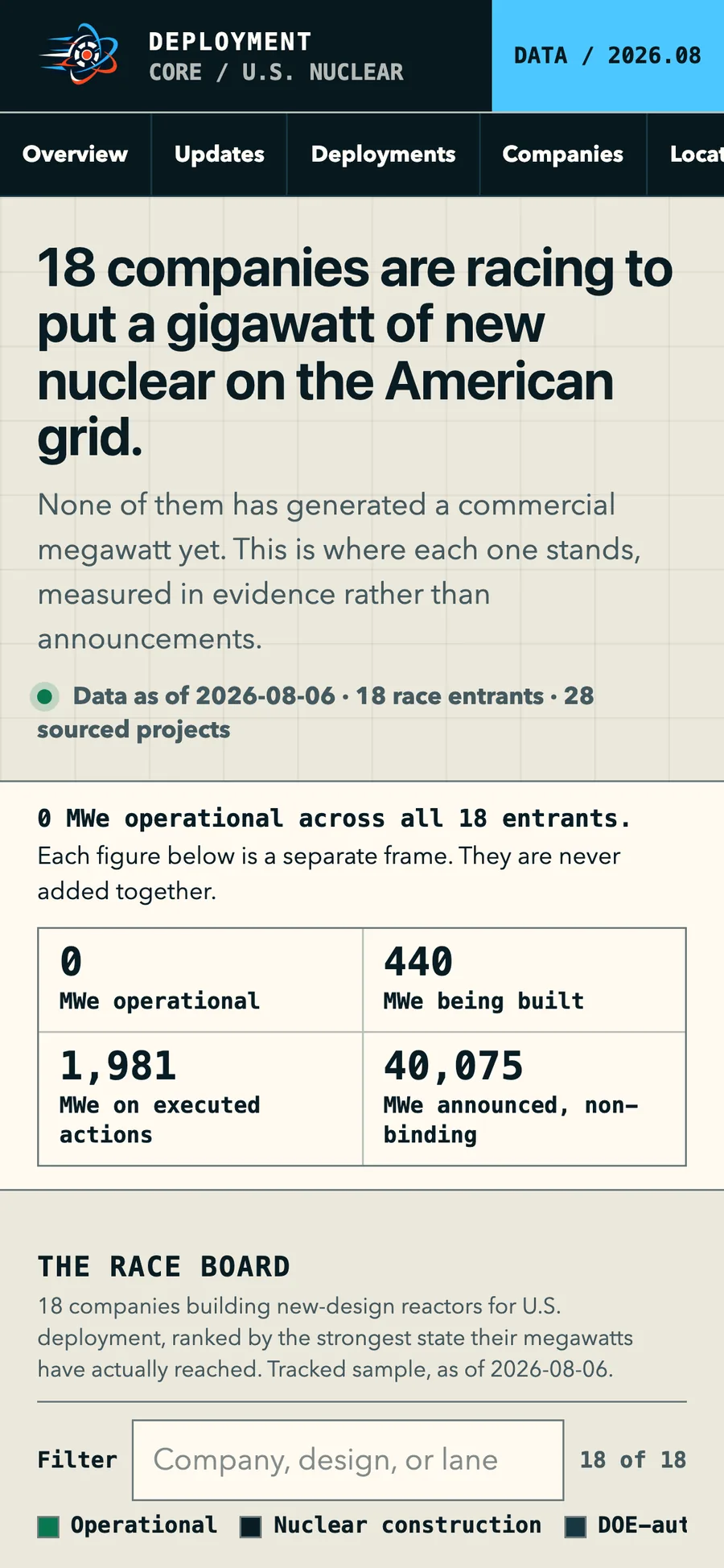
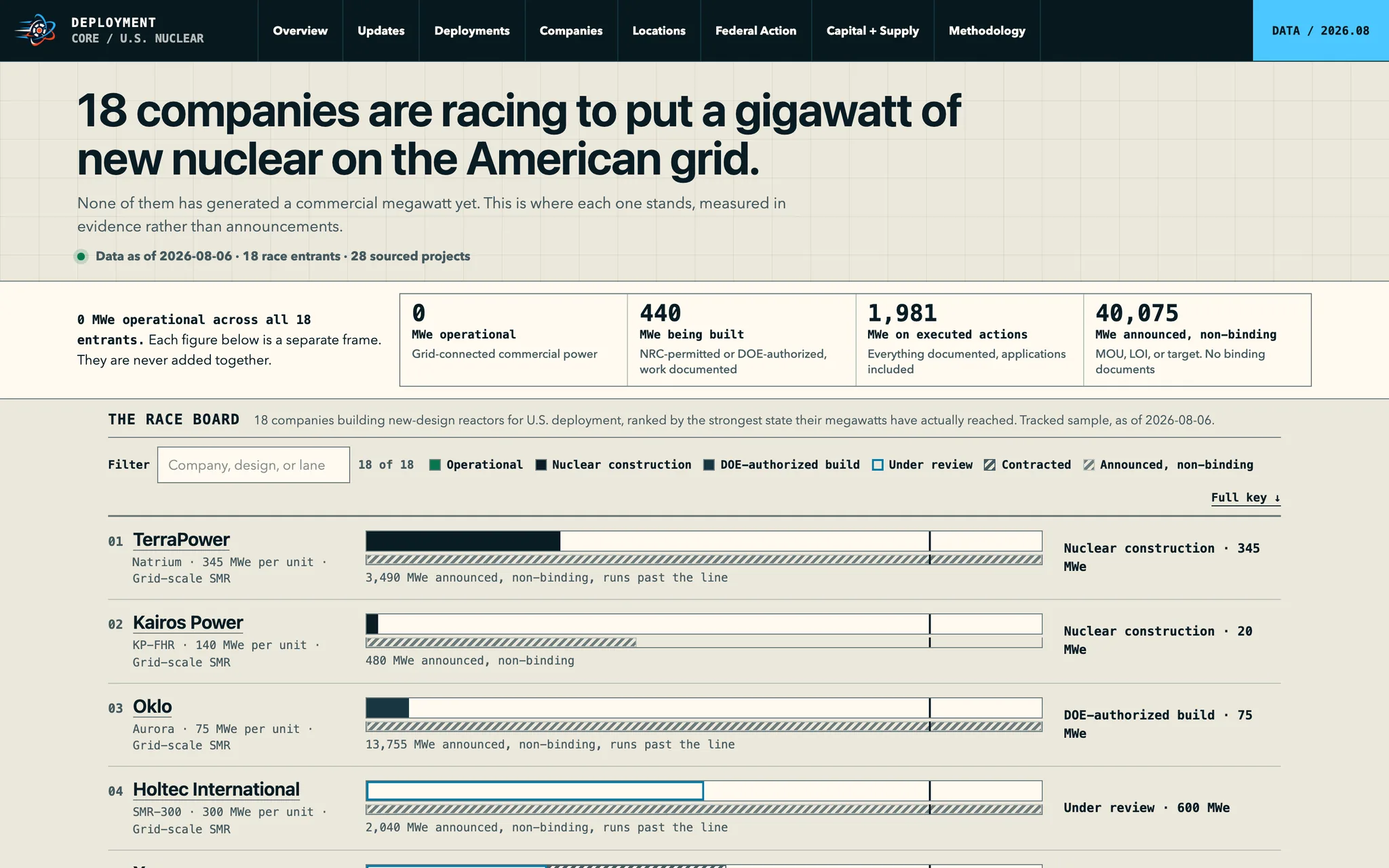
New-design nuclear is having a headline moment: tens of thousands of announced megawatts, criticality milestones, billion-dollar raises. Deployment Core scores the race in evidence. Every tracked megawatt sits in one of six bands, from operational down to announced-non-binding, the strongest state its documents support. As of August 6, 2026: 0 MWe operational, 440 MWe being built, 1,981 MWe on executed actions, 40,075 MWe announced with no binding documents.
The board covers 18 race entrants and 28 sourced projects, including all 11 initial Reactor Pilot Program reactors, with a one-gigawatt line on every bar. For scale, the last new American nuclear capacity was Vogtle Units 3 and 4: 2,234 MWe, finished in 2024.
A Look Inside
Each view shown on mobile and desktop — tap any image to open the live site.

How It Works
A static Next.js export; the dataset is one TypeScript file, and the editorial rules are enforced by tests on every push:
- One band per megawatt: capacity sits in the strongest state its evidence supports, a company-stated target never moves it, and binding and non-binding megawatts are never summed.
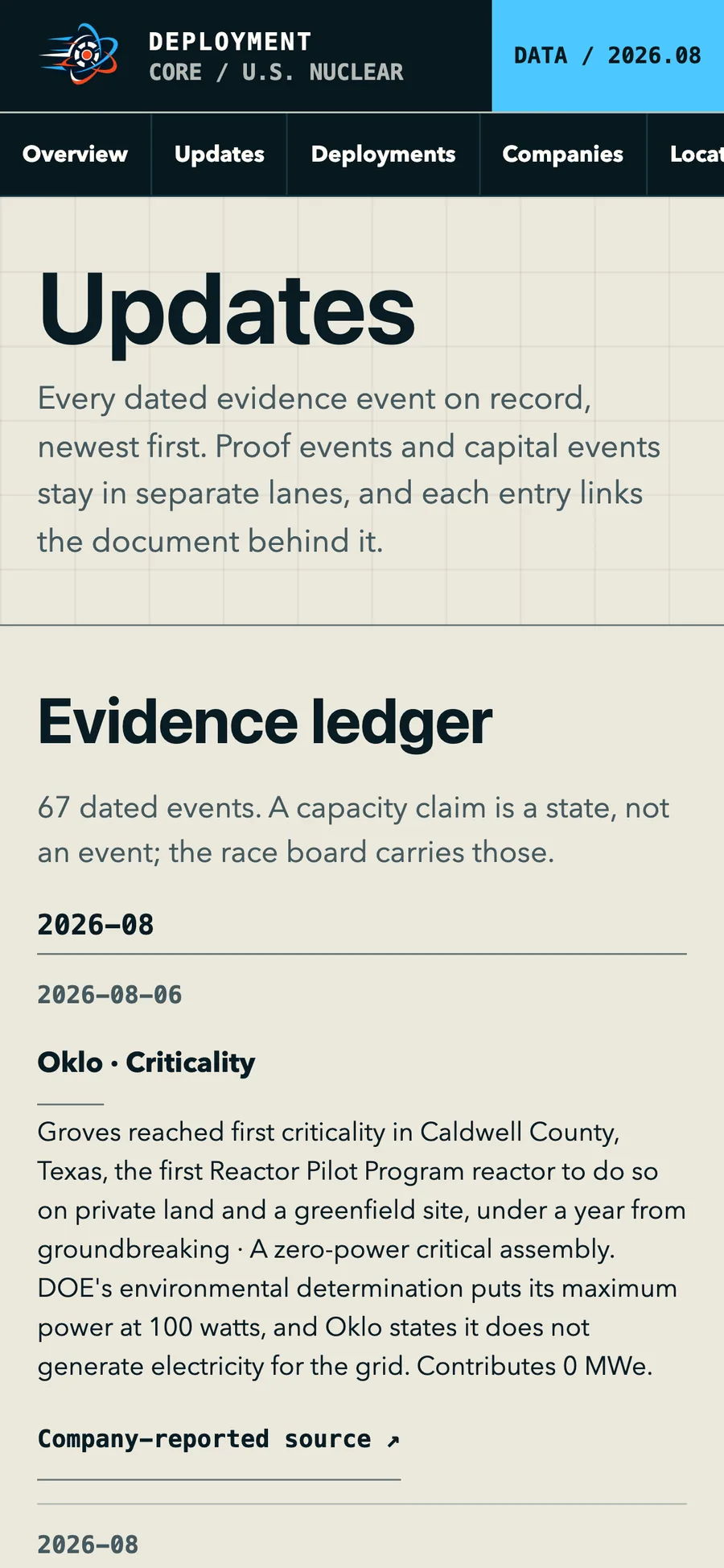
- Criticality is not generation: 2026's reactor criticalities are all on the board, each contributing 0 MWe, because a zero-power critical assembly is not commercial power.
- Sources outrank stories: every record needs a direct source link and a specific next gate; regulator documents outrank company reporting, and press-only claims are labeled.
- Deeper cuts: an evidence ledger with an RSS feed, per-company dossiers, a capital ledger that keeps closed, conditional, and appropriated support separate, a federal-action crosswalk, and a public methodology.